
Everyone Is Announcing Capacity. Nobody Is Announcing The Number That Decides It.
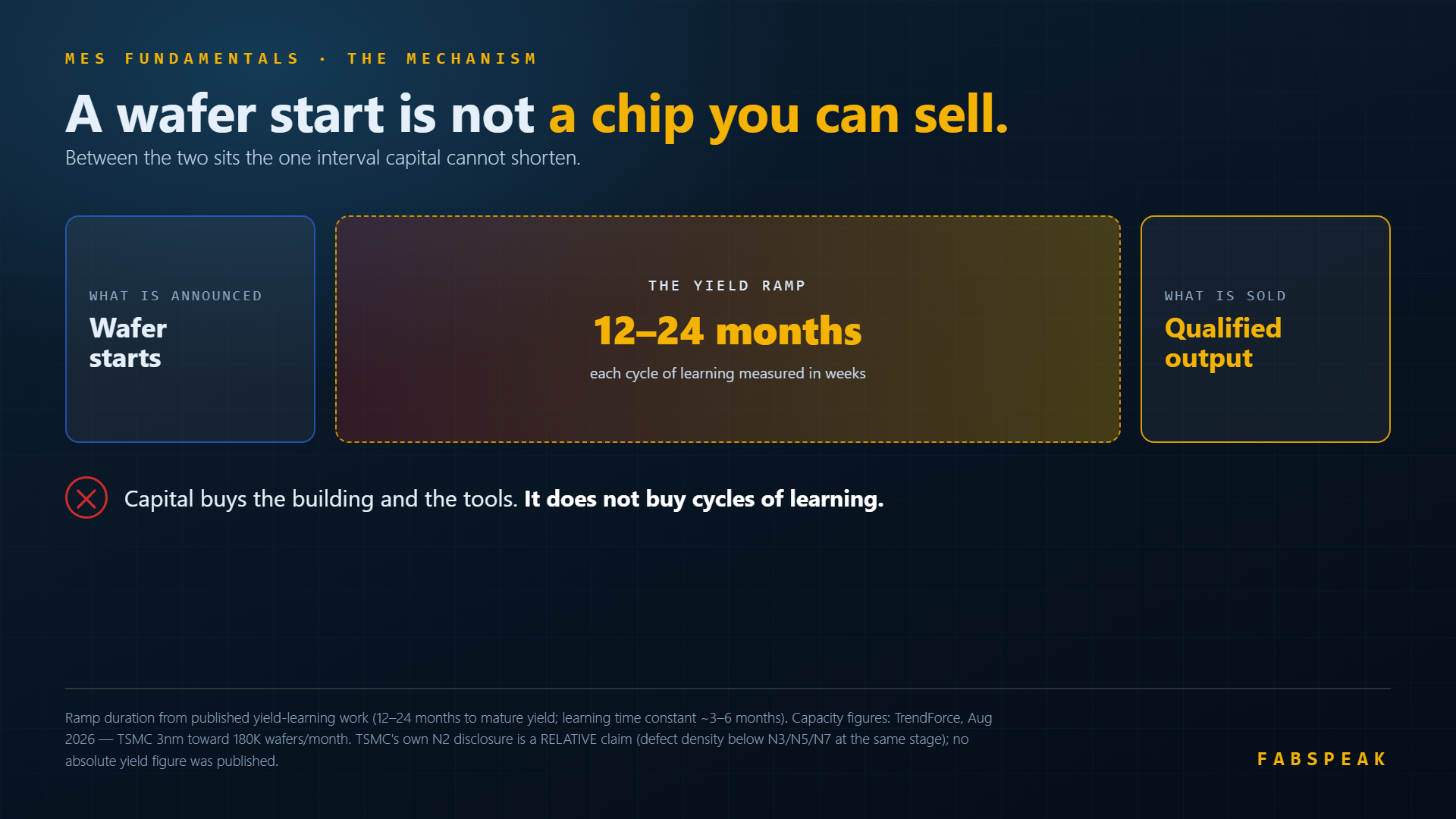
Everyone is announcing capacity. Nobody is announcing yield.
ANNOUNCED
- Nobody is announcing yield — and only one of those decides whether the wafers are worth selling.
Take any plan someone sent you this week — a deck, a schedule, a project mail. Open Microsoft 365 Copilot Chat in work mode, so it stays inside your tenant, and ask it: pull out every date commitment in this document and label each one as either the date work starts or the date output is actually usable; then show me which commitments have no usable-output date at all. That last list is where your surprises live. It is the same distinction a fab draws between wafer starts and qualified output.
- 0:00Everyone is announcing capacity
- 0:18A wafer start is not a chip you can sell
- 0:40The yield ramp: 12–24 months
- 0:58What capital cannot buy
- 1:12What TSMC actually published
- 1:32Hack of the Week
- 2:00Close
Next time someone tells you capacity was added — do you ask at what yield?
Argue with me on LinkedInReferences for this piece are in the pinned comment on the video. Nothing is cited here that cannot be linked.
Full transcript, 285 spoken words
Keep reading
All pieces
The Real Reason a Chip Fab Can't Patch Against GPT-6
GPT-6 can find a security hole in about 4 hours. The machines in a chip factory get their fixes at the next planned shutdown — once a quarter, or once a year — because patching a tool means downtime and the supplier's sign-off.

Anthropic Just Made AI Talk to Machines. Talking Was the Easy Part.
Anthropic's AI can now wire up a lab robot in about 8 hours instead of weeks. So why does a new machine in a chip factory still take six months?
Your Factory Already Solved AI's Biggest Problem
Gartner predicts that by 2027, 40% of enterprises will demote or decommission their autonomous AI agents — and the reason is not that the AI underperformed. It is that governance gaps only became visible after a production incident.