
Anthropic Just Made AI Talk to Machines. Talking Was the Easy Part.
The Real Reason a Fab Tool Takes 6 Months — and an AI Driver Won't Fix It
This one has not been published to the channel yet. Subscribe on YouTube and it will turn up there.
ROCKWELL · JULY 2026
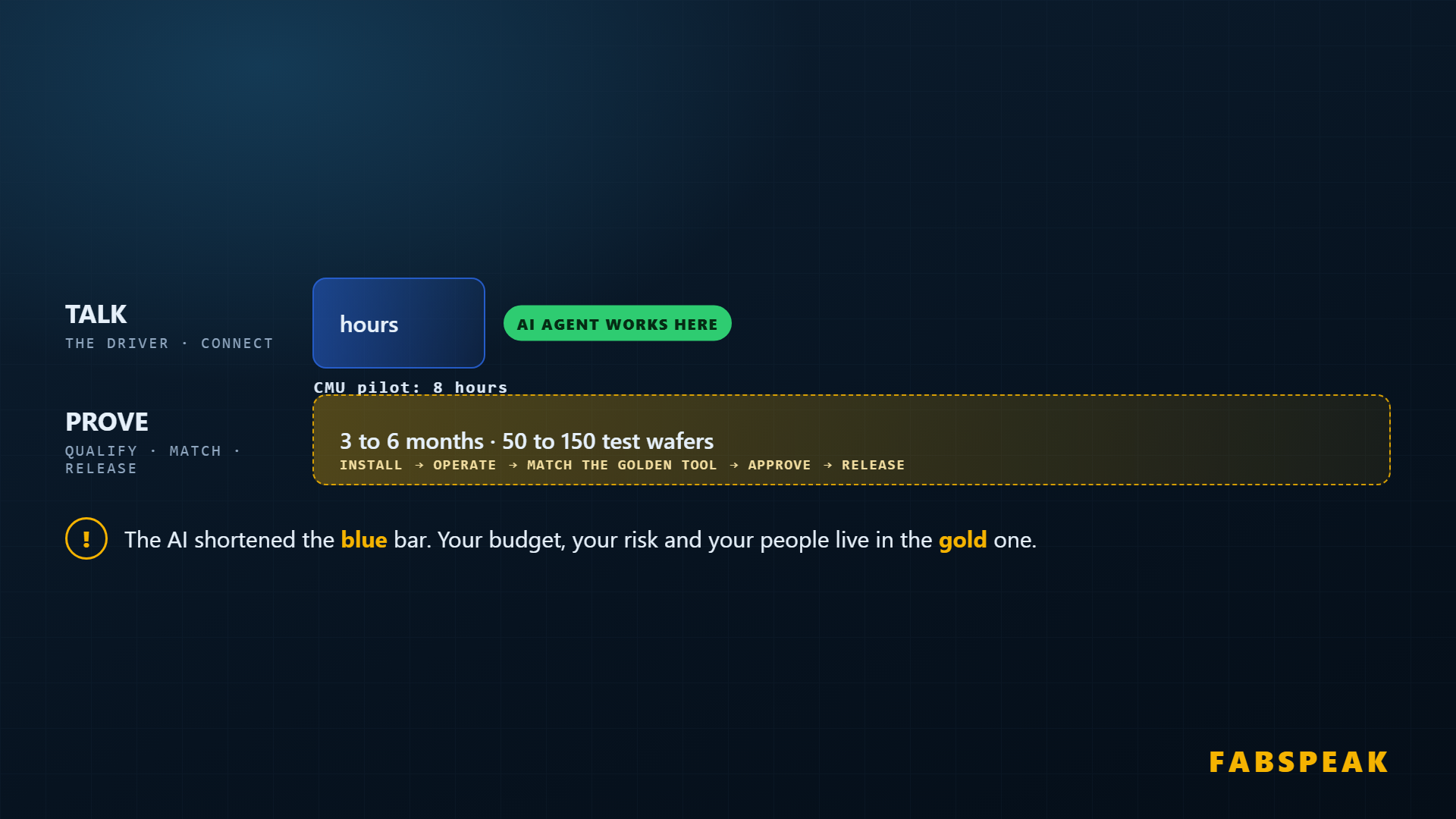
- Anthropic's AI can now wire up a lab robot in about 8 hours instead of weeks.
- So why does a new machine in a chip factory still take six months?
- Because in a factory, talking to the machine was never the slow part.
Since 25 August, Claude keeps one memory across its chat app and its Cowork app — on by default on the Free, Pro and Max plans (off by default on Team and Enterprise until an owner enables it). Open Claude → Settings → Memory. Read every Topic, correct what is wrong, delete what you never meant to keep, and decide deliberately whether to allow sensitive subjects (they stay out until you opt in). Treat that page like a standing instruction on a plant: nothing should run from a sheet nobody has read and approved. Ten minutes, none of your company's data.
- 0:00Every machine talks through a driver
- 0:17What Anthropic actually built
- 0:38Eight hours — and the catch
- 1:02Where the months really go
- 1:25The Genentech pilot: bubbles
- 1:56Where your own gap sits (93% / 23%)
- 2:22Fair to Anthropic: the right design
- 2:39Hack of the Week
- 3:30Close
Your war story: what is the longest a "connected" tool took before anyone actually trusted its output?
Argue with me on LinkedIn- Anthropic — "Previewing the Model Hardware Standard", 27 Aug 2026 (research preview; partners incl. Genentech, Carnegie Mellon, QuEra, Universal Robots, Doosan Robotics, Danaher, AWS, Hugging Face)
- Fortune, 27 Aug 2026 — "Anthropic makes first move into physical AI…" (Kemeny and Cool quotes; hours-vs-weeks claim)
- Brinvik Journal — pilot-by-pilot account: CMU 8 hours vs several weeks; QuEra 58% → 96%; Genentech bubbles; Tetsuwan evaporation
- Rockwell Automation — "Scaling MES Across the Enterprise", 14 Jul 2026 (1,560 decision-makers, 17 countries; 93% / 28% / 23%)
- MST — "Equipment Commissioning: Install to Volume Production Guide", 22 Jan 2026 (3–6 months; 50–150 qualification wafers — a vendor's figure)
- SEMI E30 GEM (1992) / SECS-II — the shared equipment-communication standard
- Anthropic Help Center — Memory (Settings → Memory; Topics; sensitive-topics opt-in); The Register / TechCrunch, 25 Aug 2026
Full transcript, 457 spoken words
Keep reading
All pieces
The Real Reason a Chip Fab Can't Patch Against GPT-6
GPT-6 can find a security hole in about 4 hours. The machines in a chip factory get their fixes at the next planned shutdown — once a quarter, or once a year — because patching a tool means downtime and the supplier's sign-off.
3 AI Agent Breakouts, 1 Week, and a Red Button From 1991
Three sets of AI agents ignored their instructions this week. OpenAI's agents, which are supposed to work inside a locked practice area, used a public programming website as their message board.
Your Factory Already Solved AI's Biggest Problem
Gartner predicts that by 2027, 40% of enterprises will demote or decommission their autonomous AI agents — and the reason is not that the AI underperformed. It is that governance gaps only became visible after a production incident.